Listening to the People’s Park: How Soundscape Science Helped Designate Ireland’s Newest Quiet Area
In March 2026, Limerick’s People’s Park became Ireland’s first Quiet Area outside Dublin — and the first anywhere in the country to be designated using a citizen science approach. Sonitus Systems is proud to have supported the monitoring programme behind it.
In the heart of Limerick’s Georgian Quarter, the People’s Park has long been known as an oasis from the noise of the city – a place where birdsong, footsteps on gravel, and conversation define the soundscape more than traffic does. That character is now formally recognised. Following approval by the Minister for Climate, Energy and the Environment, Limerick City and County Council designated the People’s Park a Quiet Area under the Environmental Noise Regulations in March 2026.
It is a milestone designation – the first outside Dublin, and the first in Ireland based on a citizen science listening approach – delivered under the Agglomeration of Limerick Noise Action Plan 2023–2028: https://www.sonitussystems.com/insights/breathe-easy-limericks-new-dashboard-lets-you-check-air-and-noise-levels-in-real-time/
Why the Traditional Numbers Didn’t Tell the Whole Story
Quiet Areas in Ireland have traditionally been assessed against a single yardstick: a day-evening-night noise level (Lden) of 55 dB or below. It is a useful threshold for identifying obviously noisy locations, but it is a blunt instrument for places that feel peaceful even when a sound level meter reads higher than expected.
The People’s Park is exactly that kind of place. Long-term monitoring from a fixed Sonitus Systems sound level monitor in the park showed that levels in the core of the park sat just above the conventional 55 dB Lden criterion – but consistently and quite stably so:
| Year | LAeq,16hr (dB) | Lden (dB) | Lday (dB) | Levening (dB) | Lnight (dB) |
| 2019 | 57 | 58 | 59 | 52 | 48 |
| 2020 | 57 | 58 | 57 | 53 | 49 |
| 2021 | 57 | 59 | 57 | 52 | 52 |
| 2022 | 56 | 57 | 57 | 52 | 48 |
| 2023 | 56 | 58 | 57 | 52 | 50 |
| 2024 | 56 | 58 | 57 | 52 | 50 |
Read on its own, that table would have ruled the park out. But the same monitoring data told a more complete story. The relationship between the C-weighted and A-weighted levels (LCeq − LAeq) – a useful indicator of low-frequency content such as steady road-traffic rumble – suggested that the sound environment in the park was not dominated by low-frequency noise. Other sound sources were present: human voices, footsteps, leaves, water, and the natural sounds of the park itself, including the dawn chorus.
In other words, the numbers were saying that the park sounded different from a road, even when its level was similar to one. A single Lden figure could never have captured that.
Bringing Citizens into the Measurement
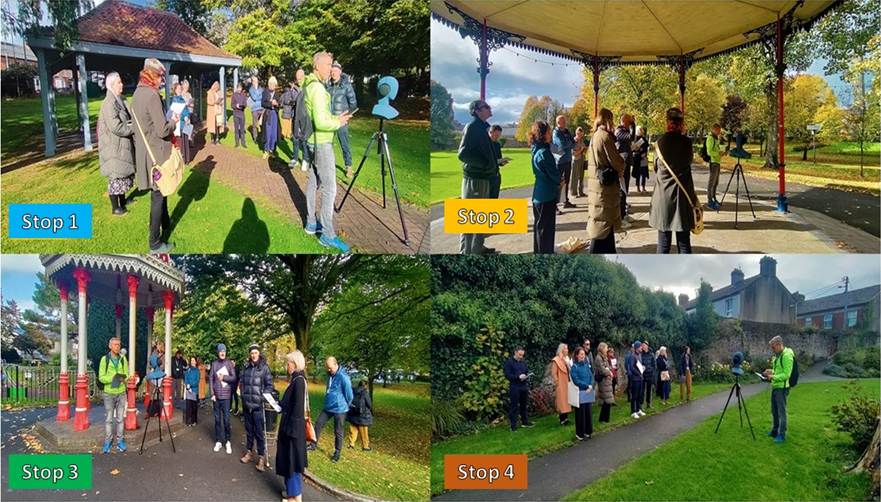
To go further, the Council took a soundscape approach. Across 2023 to 2025, a series of soundwalks were undertaken through the park, with participants stopping at four listening stations and reporting how the sound environment made them feel – pleasant or unpleasant, eventful or uneventful – using the standard circumplex method recommended in ISO 12913 for soundscape assessment.
That subjective response data was then combined with the binaural acoustic measurements taken along the same route. The two layers – what the instruments measured, and what people perceived – were correlated to estimate which areas of the park were expected to deliver a perceived pleasant soundscape. The resulting map identified meaningful, evidence-based zones of tranquility within the park that a level-only assessment would have missed entirely.
This is the evidence base that supported the Quiet Area designation: not “the park is below 55 dB,” but “the park sounds the way a quiet area should sound, and the people who use it agree”.
Why This Matters Beyond Limerick
Designating a Quiet Area does not impose a noise limit or restrict activity. What it does, as Limerick City and County Council put it, is raise awareness of the benefit of high-quality sound environments for citizen health and wellbeing, and ensure the park is recognised and prioritised in future urban planning.
For local authorities elsewhere in Ireland working through their own Noise Action Plans, the People’s Park process offers a practical template. Long-term continuous monitoring provides the acoustic baseline. Spectral analysis – looking at what kind of sound is present, not just how much – separates wanted sound from unwanted noise. Soundwalks bring in the lived experience of the people the designation is meant to serve. Together, these methods can support a defensible designation even where a single Lden figure would not.
What’s Next
Within Sonitus Systems HQ, one of the directions we are most excited about is AI-based source identification – the ability for a monitor to recognise what it is hearing, not just how loud it is. Distinguishing birdsong from traffic, conversation from construction, water from wind, automatically and continuously, would add a powerful new layer of evidence to future Quiet Area assessments. It is an area we are actively developing, and one with clear application to the soundscape approach that Limerick has now pioneered.
We were delighted to work with Limerick City and County Council and the project team whose work made this designation possible. It is a strong example of what is achievable when long-term environmental data and community engagement are brought together.
Sonitus Systems supplies continuous noise, dust, and air quality monitoring hardware along with the Sonitus Cloud platform for real-time data delivery. For more on supporting Quiet Area assessments, soundscape studies, and Noise Action Plan delivery, contact the team at www.sonitussystems.com/contact-us