Beyond the Decibel: Why Soundscape Thinking Belongs in Urban Design
For most of its history, environmental noise has been treated as a number to be kept below a limit. A development is modelled, a threshold is set, a level is measured, and the scheme either complies or it does not. That discipline still matters, and it is not going away. But anyone who has designed, planned or lived in a well-made public space knows that the number alone does not capture whether a place actually feels calm, and increasingly, the tools exist to design for how a place is heard, not just how loud it is.
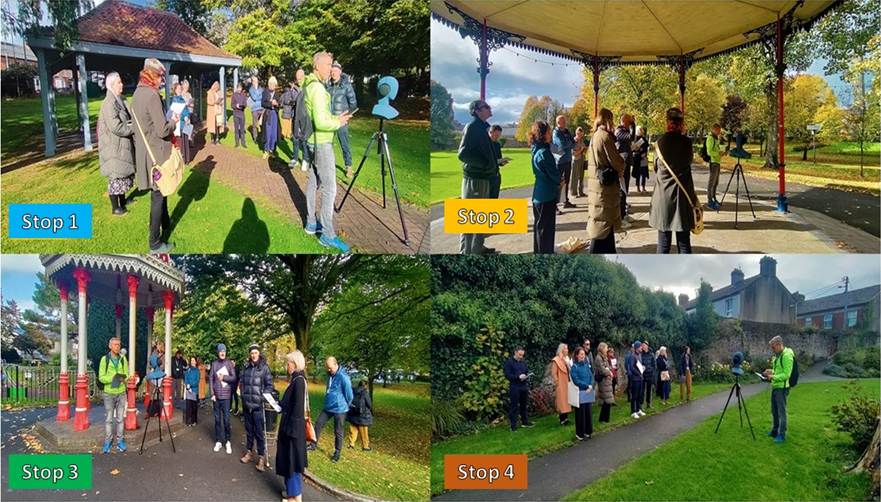
We saw this directly in the process behind Limerick’s People’s Park, which we wrote about in Listening to the People’s Park. By conventional measurement the park was not especially quiet; its measured level sat above the threshold usually associated with a tranquil space. Yet the park is genuinely restful, because the sound arriving there is birdsong, footsteps and conversation rather than the low rumble of traffic. Two places can share an identical decibel reading and offer completely different experiences. That gap is the whole argument for soundscape thinking, and the case for building it into design from the outset rather than testing for it at the end.
What a decibel does and does not tell you
A level measurement is a measure of acoustic energy. It is objective, repeatable and essential for compliance, and metrics such as Lden and Lnight underpin the noise mapping and action planning required across the EU under the Environmental Noise Directive. What a single figure cannot describe is character: whether the sound is welcome or intrusive, natural or mechanical, steady or startling, appropriate to the place or at odds with it.
Soundscape science addresses exactly this. The international standard for it, ISO 12913, defines a soundscape as the acoustic environment as perceived or experienced by people in context; putting human response, not just sound pressure, at the centre of the assessment. In practice that means combining long-term measured data with methods that capture perception, such as the soundwalks used in the People’s Park designation, where participants rated how pleasant and how eventful a space felt. The result is not a pass or fail against a limit but a richer picture: a map of where a place is experienced as tranquil, where it is lively in a good way, and where it is simply degraded.
Designing for sound, not just testing against it
The practical shift for planners and landscape architects is one of timing. If soundscape is only assessed once a scheme is built, it becomes another compliance check. If it is understood early, it becomes a design input, one that shapes decisions you are already making.
Where you place a quiet garden relative to a busy road; whether a hard façade reflects traffic noise into a courtyard or a planted buffer absorbs it; how water features or planting can introduce welcome natural sound to mask an unwelcome mechanical one; where seating, play and rest are located within a park, these are acoustic decisions as much as spatial ones, and they are far cheaper to get right on the drawing board than to remediate afterwards. Continuous, long-term measurement is what makes that possible. A short attended survey captures a moment; a fixed monitor left in place across weeks captures the daily and weekly rhythm of a site, the morning peak, the quiet Sunday, the seasonal change, and gives a design team an evidence base rather than an impression to work from.
This is where measured data and human judgement meet. Our EM2030 sound level monitors are built to collect that kind of long-term baseline in outdoor conditions, and looking at how the sound is composed (not only how loud it is) helps distinguish a genuinely tranquil space from one that merely reads as quiet on a given afternoon. Delivered through Sonitus Cloud, that record is available to everyone with a stake in the scheme, the design team, the acoustic consultant, and the local authority, as a shared, evidence-based view rather than a report that lands after the decisions are made.
From compliance to placemaking
None of this replaces the compliance framework. The same monitoring that demonstrates a scheme meets its limits can, if it is continuous and understood in context, tell a design team something far more useful: whether the place they are making will actually feel the way they intend it to. For local authorities under a duty to identify and protect quiet areas, and for designers trying to create public realm that people want to spend time in, that is the difference between measuring sound and designing with it.
The decibel will always have its place. But the most valued spaces in our towns and cities are rarely the quietest ones, they are the ones that sound right. Designing for that is well within reach, and the evidence to do it well is there to be measured.
Sonitus Systems offers both the hardware and software for a range of environmental parameters on a continual basis, with real-time information available through our Sonitus Cloud dashboard. For more details on our indoor and outdoor noise and air quality monitoring products and services, please contact the team at https://www.sonitussystems.com/contact-us