Off Track for 2030: What the EPA’s Latest Projections Mean for the Built Environment
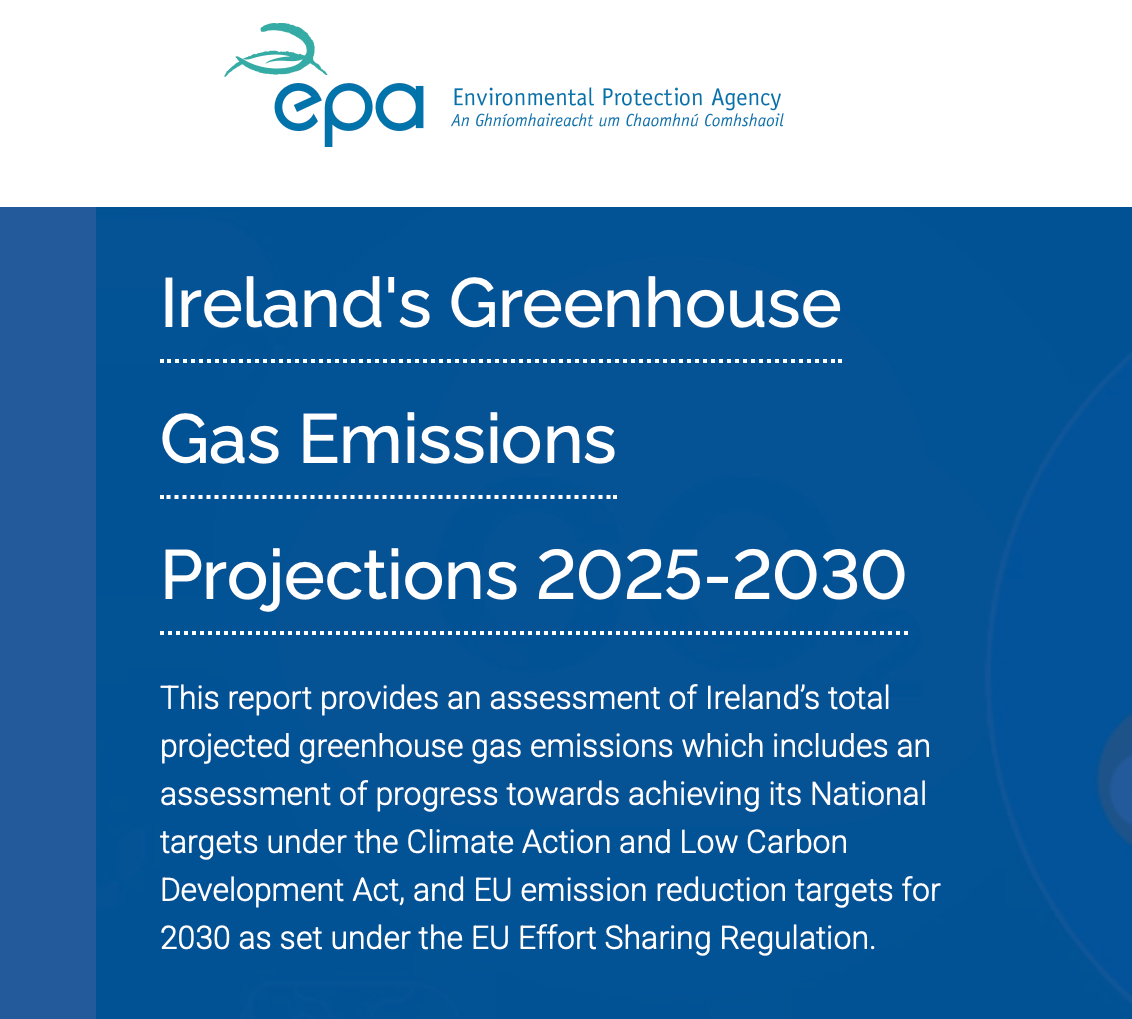
On 27 May 2026, the Environmental Protection Agency published its Greenhouse Gas Emission Projections 2025–2055. The headline is a difficult one for everyone working on Ireland’s climate transition: even with full implementation of current plans and policies, national emissions are projected to fall by only up to 25% by 2030 — less than half of the 51% reduction set in law under the Climate Action and Low Carbon Development (Amendment) Act 2021.
A widening gap in the places we build
The EPA projects that Ireland will come close to meeting its first carbon budget (2021–2025), but the second budget is now expected to be exceeded by a significant margin of 53 to 82 Mt CO₂eq. At EU level, the projections indicate Ireland will fall well short of its Effort Sharing Regulation obligation of a 42% reduction, with the EPA modelling a maximum reduction of just 23%.
Critically, for the construction industry, the Buildings (Commercial and Public) sector is named among those furthest from its 2030 sectoral emissions ceiling, alongside Transport and Industry. Residential emissions are projected to fall by up to 18% — but the EPA is explicit that this figure has been revised down, in part because of lower-than-anticipated uptake of home energy improvement measures, including heat pump installation in existing dwellings.
Decarbonisation is a construction project
The route to closing the gap from where we are now to where we need to got to is, to a large degree, a construction route. The EPA’s more encouraging numbers depend on it: the Transport projection of up to a 28% reduction rests on at least 751,000 electric vehicles on the road by 2030 and continued investment in sustainable transport, while renewable sources are expected to supply 52–59% of Ireland’s electricity by 2030 — a figure the EPA notes has been constrained by delays to projects such as offshore wind.
Retrofit and heat pump programmes, grid reinforcement, EV charging infrastructure, offshore wind, and sustainable transport schemes are all construction-intensive. Accelerating delivery — which the EPA describes as critical, given less than four years remain to 2030 — means more sites, in more communities, working harder.
The impact that sits outside the carbon accounts
That acceleration carries a local cost that does not appear in any emissions ledger – the noise, vibration and airborne particulate generated by construction itself. Decarbonising the building stock and the energy system responsibly means delivering that work without degrading local air quality or the acoustic environment around each site — and being able to demonstrate it to regulators, clients and neighbours.
This is the discipline Sonitus Systems exists to support: https://www.sonitussystems.com/products/sonitus-cloud.
Our instrumentation is built to make environmental compliance on these projects straightforward and defensible:
- EM2030 sound level monitor — automated, rugged sound level monitoring designed for reliable operation in demanding site conditions.
- DM30 Dustsens particulate monitor — ambient dust monitoring for protecting both site teams and neighbouring communities. The Dustsens range is MCERTS approved.
- DM30N Sitesens boundary monitor — combined noise and dust monitoring in a single unit for boundary and perimeter applications.
- Sonitus Cloud — automated reporting and stakeholder management that turns continuous measurement into the evidence and alerts a project needs, without manual effort.
We have already seen how central this is to major decarbonisation-aligned infrastructure. On the Luas Cross City project, where construction ran around the clock in the heart of Dublin over several years, managing noise impact was critical for Transport Infrastructure Ireland — exactly the kind of sustainable transport build-out the EPA’s projections now rely on.
Delivery, responsibly
The EPA’s message is that progress is real but insufficient, and that the determining factor between now and 2030 is the pace of implementation. As that implementation accelerates, the volume of construction across Ireland’s towns and cities will rise with it.
Robust and reliable automated environmental monitoring will not, on its own, close the emissions gap — but it is part of delivering the work that does so without trading one environmental harm for another. For the engineers and contractors carrying that work, the goal is the same as it has always been: build what’s needed, protect the people and places around it, and have the data to prove both.
Sonitus Systems offers both the hardware and software for a range of environmental parameters on a continual basis, with real-time information available through our Sonitus Cloud dashboard. For more details on our indoor and outdoor noise and air quality monitoring products and services, please contact the team at https://www.sonitussystems.com/contact-us